Have you ever moved a scent hide, only for your dog to return to the place where it had previously been hidden?
It can be tempting to assume that the dog is confused, guessing or simply remembering the old location. However, they may be responding to something very real: **residual odour**.
Residual odour is an important part of scent detection training because finding *some evidence* of the trained odour is not always the same as locating its current source. As our dogs become more experienced, we want them to be able to notice residual odour, investigate it and then continue searching when the source itself is no longer there.
This matters whether you are an instructor planning searches for a whole class or a pet dog owner enjoying scent detection at home. You do not need specialist scientific knowledge to help your dog develop this skill, but understanding what may be happening within the scent picture can prevent frustration and make training fairer.
Throughout this article, **source** means the target material that is currently hidden and **hide** means the location in which that source has been placed.
What is residual odour?
Odour is created by volatile and semi-volatile compounds released from a material into the surrounding environment. These compounds can travel through the air, collect within enclosed spaces and be absorbed or adsorbed by nearby surfaces.
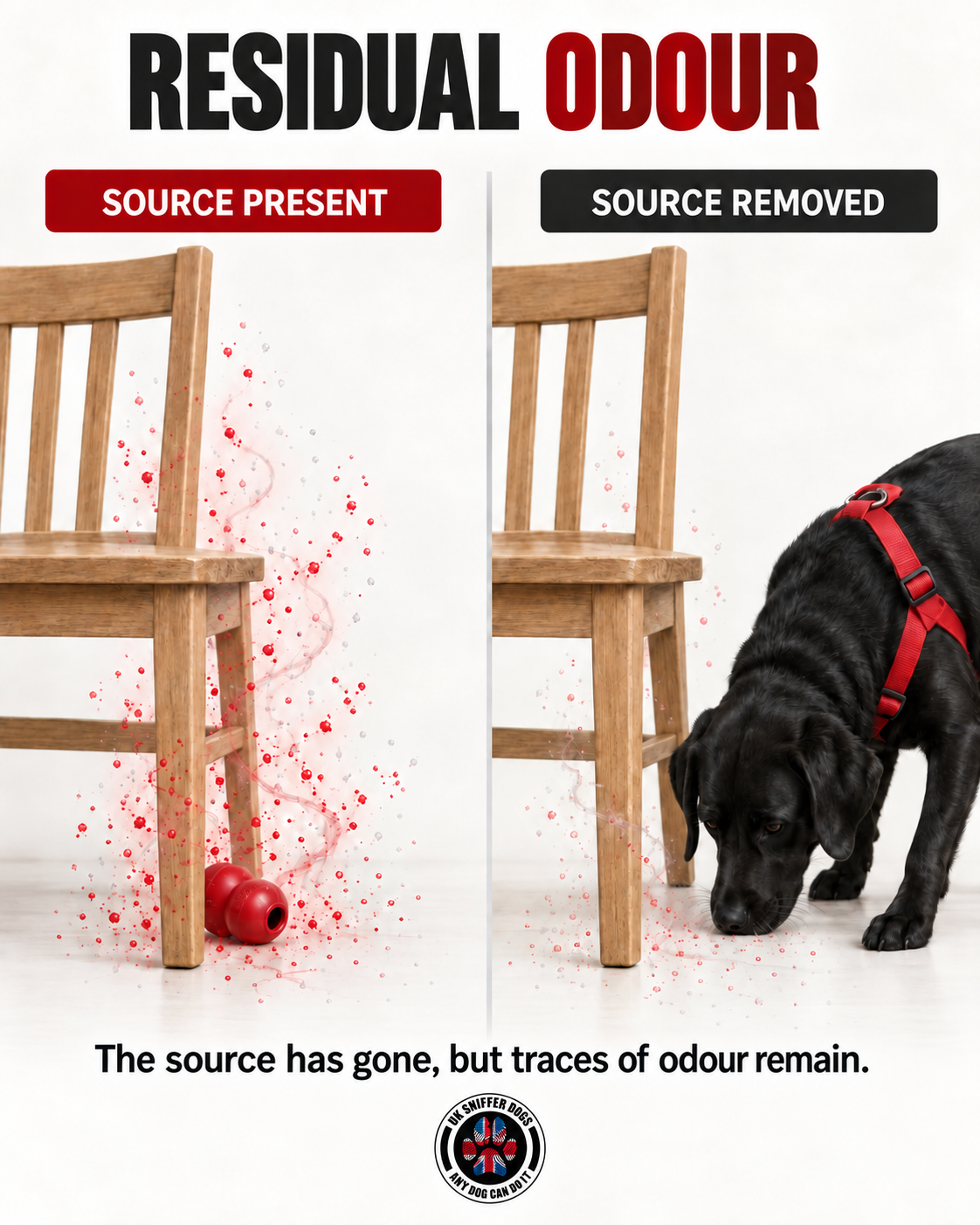
When a scent article or training aid is removed, some of those compounds may remain on the object or in the environment where it was placed. This is known as residual odour. In detection-dog research, it is also described as contamination of the working environment or “inverse contamination”.
Imagine moving a bottle of perfume from a room. The bottle may be gone, but you might still smell where it was sprayed. A dog’s olfactory system is considerably more sensitive than ours, so traces that are completely undetectable to us may still provide meaningful information to the dog.
Residual odour can be created when:
- a hide has been in direct contact with an object or surface;
- odour has collected in a container, drawer or enclosed space;
- the same search items have been used repeatedly;
- a handler touches the hide and then touches another object;
- scented equipment is stored alongside clean equipment;
- saliva or food is deposited at a previously rewarded location; or
- the hide has remained in position for a long “soak” period before being removed.
Research shows that the persistence of residual odour is not fixed. It depends on the target material, the surface, the amount of contact or contamination, airflow, temperature, humidity and other environmental conditions. Studies discussed in a major scientific review found that residues from narcotics or essential oils could remain detectable for between two and 48 hours after the source was removed. This should not be treated as a universal timescale for every trained odour: Kong, gun oil, truffle oil and other materials each have their own odour profiles and will interact differently with different environments.
Is the dog wrong for responding to it?
No. This is perhaps the most important point.
If the dog detects molecules associated with its trained target odour, its nose is doing exactly what it has been trained to do. What looks to us like an incorrect response may be an accurate detection of odour that we cannot perceive.
That does not necessarily mean we want a full indication at every trace of residual odour. The final behaviour we require depends on the task we have trained. In recreational scent detection, we generally want the dog to search independently, follow the available odour information and locate the current source as precisely as the environment allows.
The distinction is therefore not simply:
> “Target odour is here” versus “target odour is not here.”
It is closer to:
> “I can detect target odour in this area, but where is the current source from which useful odour is still being released?”
The residual and source odours are not necessarily two completely different smells. Residual odour contains compounds associated with the original target. What changes may include the quantity available, the odour profile, how it is distributed and the way it moves through the environment.
Why the current source is not always simply the strongest smell
You may hear residual odour explained as a weaker smell and the source as the strongest smell. That can be a helpful starting analogy, but the real picture is more complicated.
Odour does not spread out evenly like a coloured circle around a hide. Airflow carries it in moving, broken and constantly changing plumes. Odour can collect away from the hide, travel around objects, rise or fall with temperature changes, and become trapped in corners or enclosed spaces. Surfaces may also retain some compounds more readily than others.
Consequently, the highest concentration available to the dog at a particular moment may not sit directly above the physical hide. A dog may first encounter an area of pooled odour, work backwards and forwards through the plume, and then narrow down the location of the source.
This is why we should allow dogs time to investigate. Immediately directing them away from an old location may interrupt valuable problem-solving. Equally, repeatedly encouraging them to remain there can create handler pressure and make an uncertain response more likely.
How dogs learn the required distinction
Dogs learn through the consequences of their behaviour. If an indication at a particular odour picture consistently produces reinforcement, that picture becomes more likely to prompt an indication again.
If every search contains a hide, the hide is repeatedly placed in familiar locations, or we help as soon as the dog hesitates, the dog may learn rules that we never intended. These might include:
- “There is always something to find.”
- “Old hide locations are worth indicating on.”
- “If I stop for long enough, my handler will confirm the answer.”
- “The final item in a line-up must be correct.”
- “My handler’s movement tells me when I am close.”
Scientific discussions of detection accuracy emphasise both **sensitivity** and **specificity**. Sensitivity describes finding the target when it is present; specificity involves correctly rejecting non-targets. A dog that indicates frequently may appear enthusiastic, but high sensitivity is not useful if it is accompanied by a high false-alert rate.
Blank searches—searches in which no source is present—can form an important part of training because they teach the dog that searching does not always end with an indication. Research literature also describes blank trials as one way to reduce false alerts and positional bias. They should, however, be introduced thoughtfully so the dog remains confident and understands how reinforcement can still be earned.
What this means for pet dog owners
If you practise scent detection at home, you do not need to create highly technical residual-odour problems. Simple changes can prevent your dog from learning that particular objects or locations always contain the hide.
- Change the position of the hide between searches.
- Avoid using the same box or household object as the scented item every time.
- Keep your scented article and clean search equipment separately stored.
- Occasionally search a completely different room or outdoor area.
- Allow your dog to investigate without repeatedly pointing, asking “where is it?” or standing beside the correct location.
- Finish while your dog is still enjoying the activity, particularly when introducing a new challenge.
If your dog revisits an old hide location, pause before assuming they have made a mistake. Watch what happens next. They may sniff, gather information and move away independently. That decision is valuable and does not need to be interrupted.
If they offer a full indication where the hide used to be, remain calm. Do not tell them “no” or pull them away. Reset the exercise and make the contrast clearer on the next repetition. For example, use a fresh item for the current source, keep it relatively accessible and avoid adding further difficulty at the same time.
Pet owners should also remember that scent work is meant to be enjoyable enrichment. Precision can be developed gradually; there is no benefit in trying to catch the dog out.
What this means for instructors
For instructors, residual odour affects not only an individual dog but potentially every dog working the same search area. Later dogs may encounter a very different scent picture from the first dog, especially when hides have remained in position, dogs have been rewarded at source or equipment has been moved between repetitions.
When planning class searches:
- keep a written or photographed record of every hide location;
- consider the order in which dogs work and the time each hide has been allowed to soak;
- use enough equipment to rotate genuinely clean items into the search;
- prevent clients from handling hides and then touching search articles;
- explain that interest in an old location may be an honest response to residual odour;
- avoid labelling every non-source response as handler error or dog error;
- adjust the exercise for each team rather than expecting inexperienced dogs to solve an advanced discrimination problem; and
- include straightforward, confidence-building finds alongside more complex searches.
Instructors can also help owners learn to recognise the difference between **interest**, **working odour** and a trained **final indication**. A pause or a return to an old location is not automatically an indication. Teaching handlers to observe quietly reduces the chance that their body position, lead tension or verbal encouragement turns a moment of investigation into a committed response.
When several dogs use the same area, perfect control of residual odour may be impossible. The aim is to understand and manage it, keep records and avoid claiming certainty about what a dog could or could not smell.
A simple exercise for introducing residual odour
This exercise can be used by an instructor or a pet dog owner, but it is most suitable for a dog that already understands its trained odour and has a reasonably confident indication. **Begin this exercise using Kong as the target odour.** Kong provides a clear, familiar starting point for dogs trained through the UK Sniffer Dogs system. Once the dog confidently understands the difference between residual odour and the current source, the exercise can gradually be repeated using subtler target odours such as gun oil or truffle oil. Blank searches can be added later; the dog does not need to complete one during its first residual-odour session.
1. Set up a simple line-up of several clean, visually similar search items.
2. Place the Kong source—a small piece of Kong prepared and handled in the same way you normally use it—in one item and allow an appropriate soak time.
3. Run an ordinary search and reward the dog at source.
4. Remove the dog from the area while you reset the search.
5. Using clean handling procedures, move the Kong source into a genuinely fresh item in a different position. Leave the previously used item in the line-up so that it may retain some residual odour.
6. Bring the dog back and allow them to search without directing them away from the old location.
7. If the dog investigates the previous hide and then moves on, remain neutral and allow that decision to develop. Reward generously when the dog locates and indicates on the current source.
Make the contrast easy at first. The current hide should be accessible and suitable for the dog’s experience. The aim is not to catch the dog out or manufacture a mistake. We are creating an opportunity for the dog to compare odour pictures and discover which response earns reinforcement.
Owners working alone can place the dog safely in another room while resetting the search. In a class, the instructor can prepare the hides so that clients remain unaware of the correct location and cannot inadvertently guide their dogs.
If the dog offers a full indication on the residual location, avoid correcting or showing frustration. Calmly end or reset the repetition, consider whether the exercise was too difficult, and make the next search clearer. The dog has given you useful information about its present understanding.
Only change one main difficulty at a time. Increasing the delay, using more absorbent surfaces, adding complex airflow and introducing inaccessible hides simultaneously makes it difficult to know what the dog is learning.
Blank searches and residual odour
A useful progression is to remove the source completely and ask the dog to search an area containing a previously used location. This is more difficult because there is no current source to resolve the search.
Before doing this, decide how your blank search will finish. Some handlers use a separate “finished” behaviour, while others call the dog away after observing a complete and systematic search. Whichever method you choose, the dog should still receive reinforcement for searching well and leaving residual odour rather than feeling that a blank search means their effort was wasted.
Blank searches should not dominate training, particularly with inexperienced dogs. They are one part of a varied programme containing clear, achievable hides, different numbers of hides and plenty of successful reinforcement at source.
For a pet dog owner, there is no urgency to introduce blank searches. Build a confident search and indication first, then ask your instructor for help if you are unsure how to finish or reinforce a search in which no hide is present. For instructors, the difficulty and proportion of blank searches should be appropriate to the experience of each dog-and-handler team rather than applied identically across a class.
Good handling and record keeping matter
Residual odour cannot always be eliminated, but careful handling can prevent unnecessary contamination and make training easier to interpret.
- Keep target and clean equipment separate.
- Store odours in suitable primary and secondary containers.
- Use tweezers or clean gloves when handling hides.
- Change gloves after touching target material.
- Avoid touching clean search items with contaminated equipment.
- Do not place scented items directly onto surfaces unless this is intentional.
- Rotate or clean equipment appropriately.
- Record where hides have previously been placed.
- Include control items handled in the same way but without target odour.
Recording old hide locations is especially helpful. A response that appears false may actually be a correct response to residue from an earlier search. Without records, we can easily blame the dog for a problem created during the set-up.
What should handlers look for?
Residual odour can produce subtle changes in behaviour. A dog may pause, turn back, investigate for longer, check several sides of an object or begin an indication and then reconsider. These behaviours should not automatically be labelled as uncertainty or disobedience. They may show that the dog is processing a complicated odour picture.
Watch the whole search rather than focusing only on the final indication. Video can be invaluable because it allows you to review when the dog first entered odour, how the search pattern changed and whether your own movement influenced the outcome.
Whether that handler is a pet owner working at home or an instructor demonstrating within a class, their role is to provide a thoughtfully designed problem, observe carefully and allow the dog enough time to solve it. Precision grows through well-planned reinforcement, not through pressure.
The “scent ghost” is part of the learning
Residual odour is not something we need to fear, nor is it proof that a dog has made a mistake. It is a genuine part of the scent environment.
Our aim is not to stop the dog noticing where odour has previously been. That sensitivity is one of the qualities that makes scent detection so remarkable. Instead, we want to help the dog use all the available information and make an increasingly precise decision about whether a current source is present.
With varied hide placements, carefully introduced blank searches, clean handling, accurate records and patient reinforcement, dogs can learn that a “scent ghost” is worth investigating—but it is not necessarily the end of the search.
Would you like to develop your dog’s scent detection skills with clear, progressive training you can enjoy together at home? The Sniffer Dogs Academy gives you access to our complete Bronze, Silver and Gold programmes, step-by-step training videos, progression grades, certificates, monthly challenges and a supportive online community where you can ask questions and share your progress. Whether you are completely new to scent work or ready to develop more advanced skills such as independent searching, blank searches and understanding residual odour, the Academy allows you to work at your dog’s pace while building confidence, accuracy and a genuine love of searching. Join the Sniffer Dogs Academy today and discover just how much your dog’s nose can do.

 07545 893631